
CommBank
Helping Australians save money on fuel
Research, Ideation, Experimentation, Product Strategy, UX and Visual Design
↓

Background
A zero to one product idea. This case study details how we got from a research insight to a product used by over 100,000 customers, without betting on a big build upfront.
-
Through cost-of-living research, we discovered that Australians were increasingly turning to third-party fuel price apps to save money on fuel. Rather than jump straight to a solution, we designed a series of lightweight experiments with real CommBank customers to test whether there was genuine demand before we invested in building anything meaningful.
-
In 2023, fuel costs were one of the most visible pressures of rising cost of living in Australia. NSW customers were losing around $20 per tank to price differences of up to 40¢/L between stations less than 3km apart. Not because cheap fuel wasn't available, but because finding it in the moment was too much effort. Existing fuel apps put the work on the customer, requiring them to take the initiative and search for the best price themselves.
-
We thought CommBank could do better by using its view of customer spending patterns to surface the right information at the right time, without customers having to go looking for it. By harnessing CommBank's AI-powered customer engagement engine to analyse transaction history and predict when a customer would next need to refuel, we could notify them at exactly the right moment with the cheapest nearby option already identified. No searching, no scrolling, just a timely nudge that did the work for them.
The approach
Rather than design a full product and ship it, we deliberately started small. The hypothesis was simple: if we can show customers a relevant, timely fuel alert, will they act on it? We ran three progressive experiments to find out, each one building on what the last one taught us.
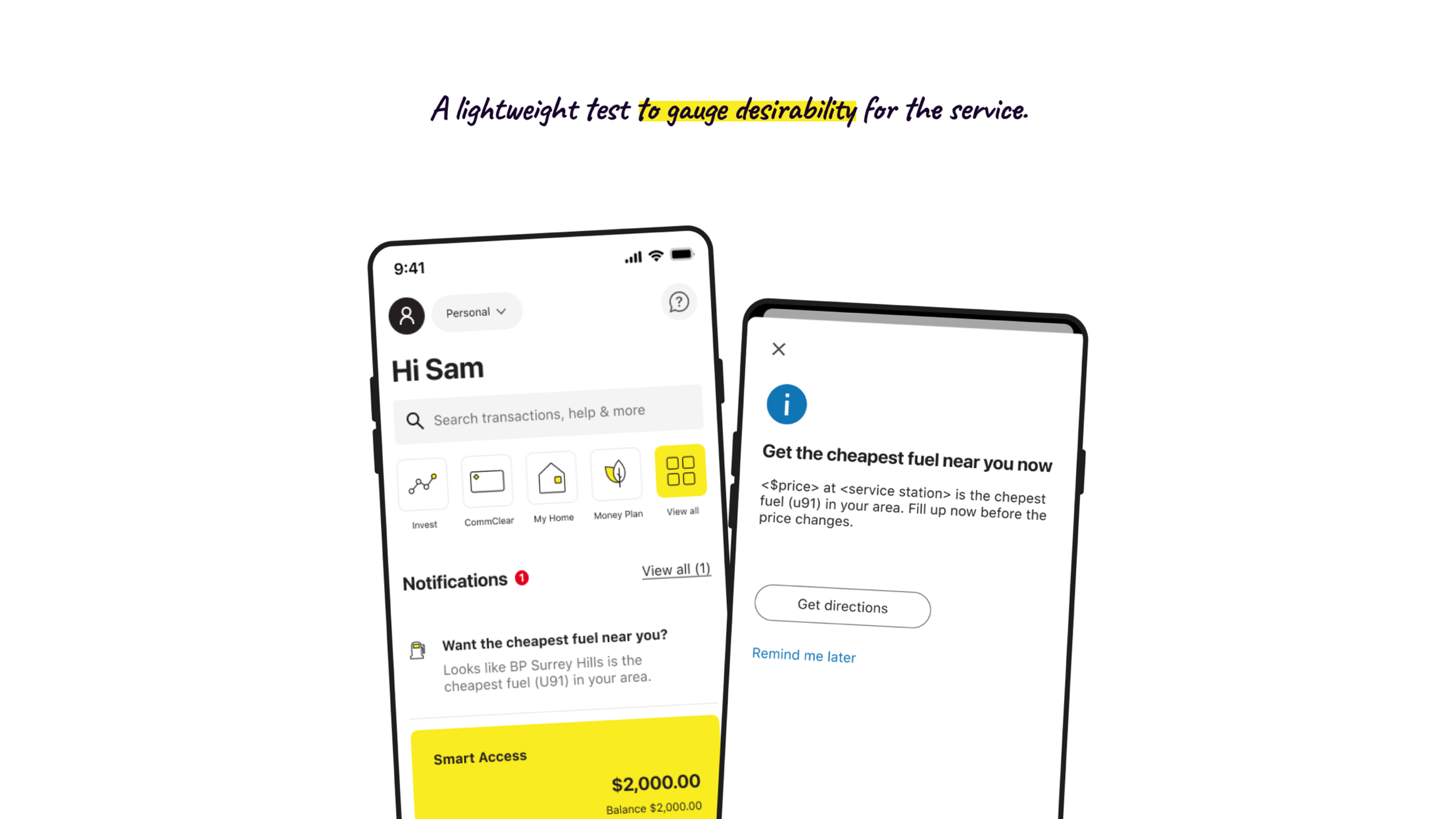
Experiment one
Testing the core idea
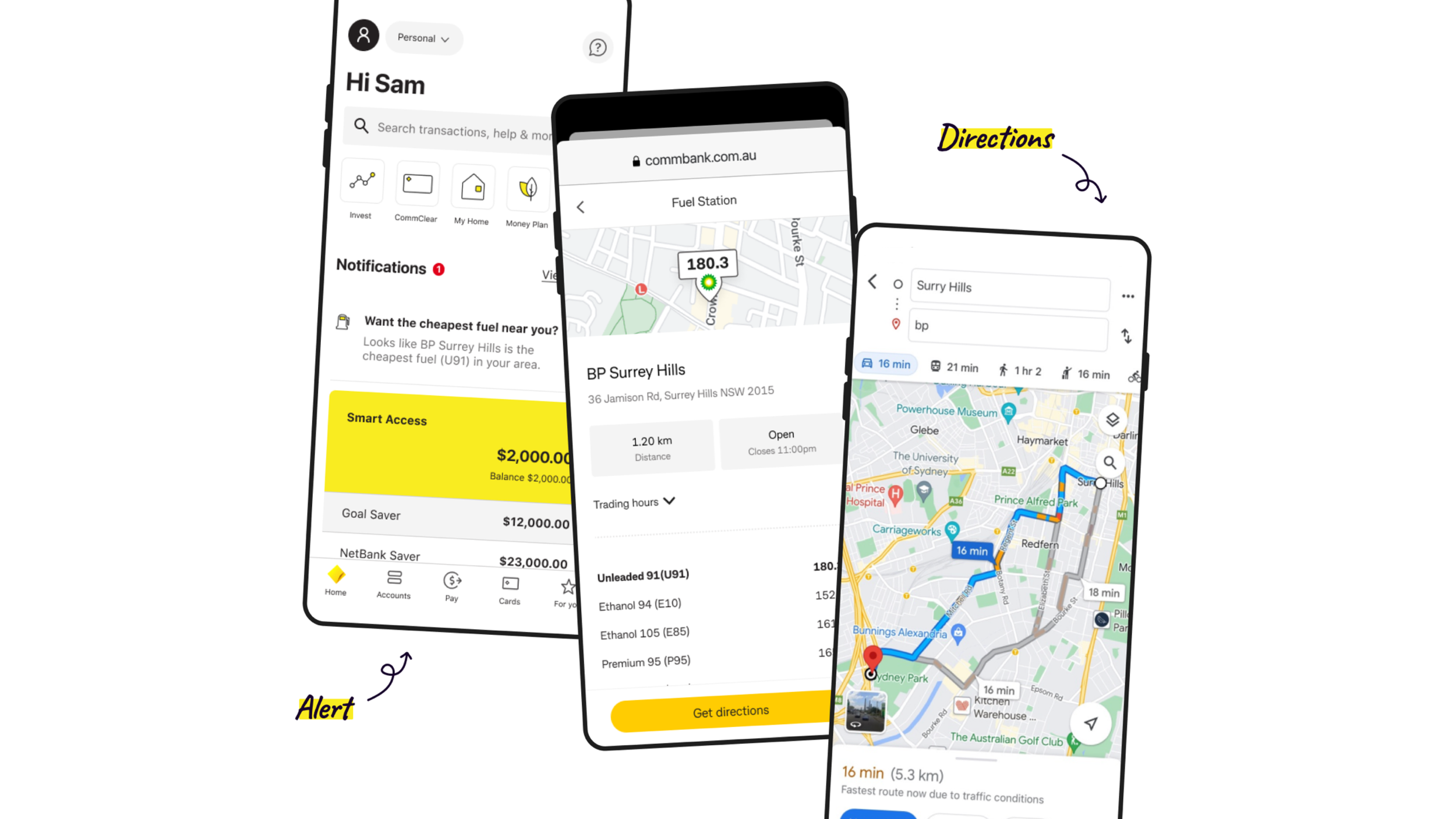
We stripped the concept back to its simplest form: a single push notification telling customers where the cheapest nearby fuel was, right now. The experiment ran for five weeks across 50,000 customers. If they tapped it, it opened directions to the station. Nothing more.
The point wasn't to build a product. It was to find out if customers would engage with the idea at all. They did.
Experiment two
Testing a fuller experience
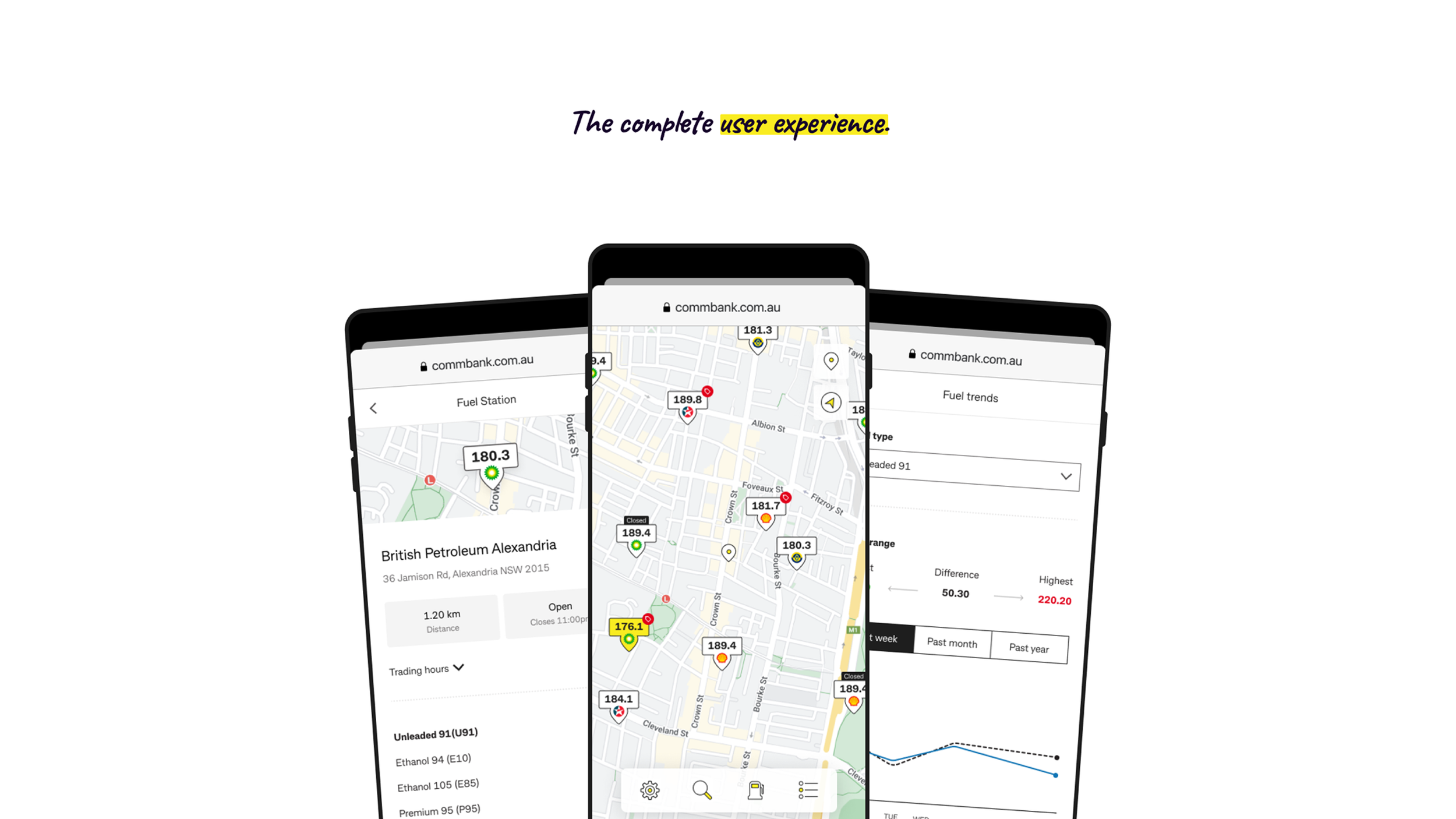
With desirability validated, we designed and built a production pilot inside the CommBank app that included predictive alerts, a fuel station map and price comparisons. We then released it to 250,000 pre-selected customers over six months.
This was the first time we could see how customers actually used the experience end to end.
Experiment three
Refining for scale
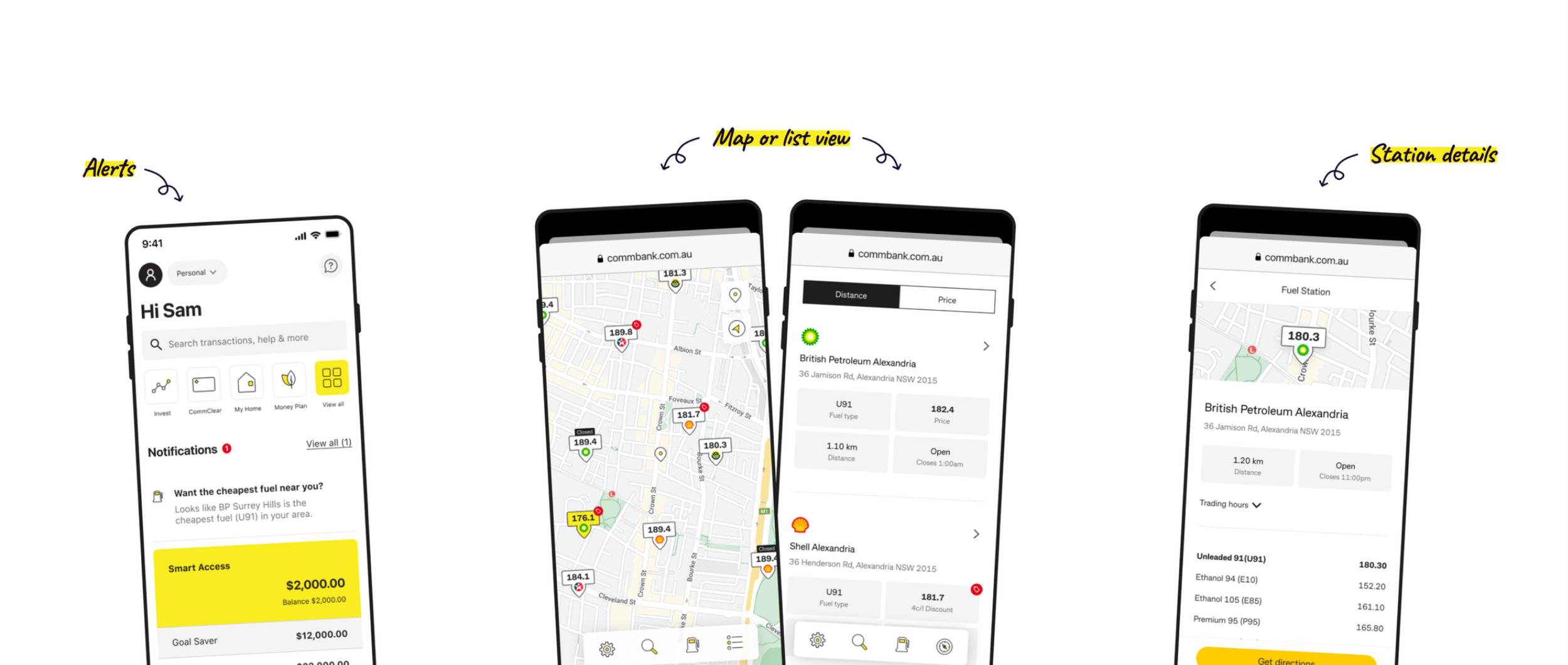
We analysed everything the pilot taught us, redesigned for usability, updated the information architecture to support new features, and aligned the visual design with CommBank's updated design system.
We then released to all NSW customers with plans to go Australia wide in the near future.
Reflections
The approach: A zero-to-one product feature inside a major bank carries real risk (engineering time, stakeholder buy-in, risk and compliance overhead). Running experiments let us build confidence progressively, only investing more when the previous step proved its worth. By the time we built the full product, we already knew customers wanted it.
The outcome: Over ten months from June 2023 to March 2024, Fuel Finder saved CommBank customers almost $2 million. More than 109,000 customers opted in, generated 664,000 fuel transactions through the product, and saved an average of 5.45% per fill, roughly $199,000 in collective savings every month.
My role: I lead the design from the first research session to the moment Fuel Finder launched. I owned the project end to end, conducting customer research, defining product strategy, facilitating ideation, designing and prototyping, and working closely with engineers to deliver a production-ready experience.